What Happens During a Wedding Ceremony? A Step-by-Step Guide

As an experienced celebrant, it's easy to forget that many couples have never actually seen a wedding ceremony up close. Unless you've been to several weddings recently, you may not know what normally happens, what the legal parts are, or how everything fits together.
The good news is that ceremonies are much less mysterious than they seem. While every ceremony is different, most follow a similar flow. This guide will walk you through what usually happens, explain why each part is there, and show you where you can make the ceremony your own.
Before the Ceremony Begins
A lot happens before your ceremony even begins! I’m there in plenty of time to set up and check my speaker, get the music organised, and to catch up with each of you before the ceremony. You may both be getting ready at your venue, or you may be arriving separately. Either way, I’ll check in with each of you privately, even if it means meeting one of you as you as you step out of the car.
Unless you’ve signed it earlier, this is the time I get you to sign the Declaration of No Legal Impediment. This is a declaration that states that you’re over 18, not currently married and not in a prohibited relationship. I also check that you’re happy to be getting married, and that you’re not feeling coerced in any way.
Most people have at least a few butterflies at this point. That’s completely normal. In fact, I’d be more surprised if you weren’t feeling nervous.
Just before your ceremony starts, I’ll make sure your guests are in the right place and ask them to switch their phones to silent. If you’ve chosen an unplugged ceremony, I’ll also ask them to put their phones away completely. Then I’ll introduce your photographer and musician (if you have them).
The Entrance
The music starts, your guests turn around, and it’s finally time to enter. So how do you make your entrance?
Traditionally, one person waits at the front while the other makes their entrance. But traditions are only one option. A couple of my favourite weddings have had grooms entering to songs which suited them perfectly. I’ve also conducted several weddings where the groom entered with one or both parents.
So, some people choose to enter with one or both parents. Others enter with their children, on their own, or together. One of my couples actually danced in from opposite directions! Some couples have large wedding parties, while others don’t have one at all.
There isn’t a right or wrong way to make your entrance. The best entrance isn’t the most traditional or the most elaborate. It’s the one that feels right for the two of you.
If one of you is making a traditional entrance, I’ll usually invite your guests to stand just before you walk in. If you’re entering together or doing something a little different, we can decide what works best for your ceremony.
The Welcome
The welcome does more than simply greet your guests. It marks the point where everyone settles, takes a breath and turns their attention to the reason they're all gathered together.
This is where I introduce myself and welcome your guests. I'll also let your guests know what to expect over the next 20 to 30 minutes, helping everyone relax and settle into the ceremony.
While not every ceremony includes an Acknowledgement of Country, if you have chosen to include one, this is where it goes. When I include this in a ceremony, I try and ensure that it’s relevant for the area in which the ceremony is taking place.
I can also acknowledge loved ones who may have passed away, or are not be able to be at your ceremony because of illness, distance or other circumstances. Sometimes couples leave an empty chair, with or without a photo on it, if a close family member has passed away. Sometimes a bride or groom will carry something of personal significance to the one who has passed away.
Setting the Scene: Why Your Ceremony Matters
I like to remind everyone just how significant this day is. For the two of you, it's one of the biggest days of your lives. For your family and friends, it's a day they'll remember for years to come.
And I let your family and friends know that they matter too. They're not there simply to fill seats. They're there because they love you, and because you've chosen to share this moment with them.
You may have additional acknowledgements that you’d like to include in your ceremony. Some couples like to thank their parents and acknowledge the role they've played in shaping the people standing here today. Others choose to recognise children, special family members or members of the wedding party. These personal acknowledgements help make every ceremony unique and often become some of the most meaningful moments of the day.
From there, it's time to tell your story—how the two of you met, how your relationship grew, and how you arrived at this moment together.
Your Story
Up until now, your ceremony will have followed a similar structure to most wedding ceremonies. Your story is where your ceremony really starts to feel like your wedding.
Your story isn’t something that I make up there and then, on the day. It’s built over a period of time. Using the questionnaires you complete and the conversations we have, I learn about how you met, challenges you may have faced, funny moments you’ve shared, what you love most about each other, and how your proposal unfolded. I then weave these moments into a flowing narrative that sounds just like you. Your guests will be able to recognise the two you in every story, every laugh and every emotional moment.
Your story will very probably have some humour in it; however, the humour won’t be forced or come at the expense of either of you. It will be humour that fits naturally into your story. My aim is not to embarrass you, it’s to give those moments of joy that comes naturally with laughter. It’s to celebrate the two of you completely.
Your guests will probably know parts of your story, but very few people will know all of it. This may be the first time everyone hears how your relationship began, what brought you together, and the little moments that have shaped your lives as a couple.
After conducting nearly 300 ceremonies, I’ve noticed this is the part that people talk about afterwards. Guests laugh at the stories they recognise, learn things they didn’t know, and begin to understand what makes your relationship unique. They won’t remember every word of your story. But they will remember the way it made them feel.
The “I do” question
Saying “I do” is a traditional and joyful part of a wedding ceremony. It’s at this point that I ask if you freely choose to marry the other person, a public confirmation of your commitment to each other. What it isn’t is a legal requirement, or the words to make you legally married.
While the purpose of the question remains the same from ceremony to ceremony, the wording can be completely yours. I often weave details that you’ve given me into this question. And your answer doesn’t have to be “I do”. It can be “I will”, “absolutely” or, “with all my heart.” And in a couple of my weddings, the groom has answered, “Bloody oath”.
This part of the ceremony creates a natural pause before the legal words that follow, a chance to answer clearly (and in some cases, very loudly) in front of your family and friends. It’s a simple question, but one you’ll probably remember for the rest of your lives.
The Monitum (My Legal Words)
These are the words which are required by Australian law and every celebrant must say them before the legal vows. They identify me as an authorised celebrant and state the legal definition of marriage in Australia.
Although the Monitum is one of the legal requirements, I don't see it as an interruption to the ceremony. It's simply the point where we acknowledge that this beautiful, personal celebration is also creating a legally recognised marriage.
Your Vows
Your vows are the promises you are making to each other. They are one of the few moments in your ceremony that you are speaking to each other, rather than listening to your celebrant. This is often the most emotional part of your ceremony, with tears (yours and your guests) often shed.
Every couple being married by a civil celebrant in Australia must say the legal vows to each other. These are the words that make your marriage legally valid.
The words you will speak are:
“I call upon the persons here present
To witness that I (full name)
Take you (full name)
To be my lawful wedded husband/wife/spouse.”
Many couples also choose to share personal vows, either immediately before or after the legal vows. This is where you tell your partner what you love and appreciate about them, and your promises for the future.
Your personal vows don’t need to be long. They don’t even need to be the same length as each other’s. One of my grooms shared his three lines, while his bride shared her three pages, prefacing her words with, “I know you’re a man of few words, while I’m a woman of many words.” They don’t have to be funny or make people cry, they just need to sound like you.
Some couples share their vows with each other privately at some time before their ceremony, and then again during their ceremony, while others share them for the first time during the ceremony. Some share them in private only, either before or after their ceremony. And many couples choose to stick with the legal vows only. Choosing not to write personal vows doesn’t make your ceremony any less meaningful. Some couples are simply more comfortable expressing themselves in other ways.
Laughing, crying and needing a moment to take a few breaths while reading your vows are all completely normal responses to this highly emotional moment. I’ll give you all the time you need. And if you really can’t finish your personal vows, one of your attendants or I can finish reading them for you.
Your vows don’t have to be perfect, they just need to be genuine. More information on writing personal vows can be found here.
Exchanging Rings
You’ve made your promises. Now you’re giving each other something that you’ll wear long after the ceremony is over.
While an exchange of rings isn’t a legal requirement, many couples choose to include them in their ceremony. It’s a meaningful part of the ceremony and a tradition they want to include, one which results in beautiful photos. Sometimes both parties exchange rings, sometimes only one gives a ring, and sometimes neither do. It’s totally up to you.
As with other parts of your ceremony, your ring exchange can be completely personalised.
I’ll invite you to place your ring on your partner’s finger while repeating a few words, then to slide it on completely once your words are finished. This can be one of the lighter moments of the ceremony… rings sometimes don’t go on easily due to nerves, warm weather or sweaty hands. It’s completely normal and they always do go on eventually.
You're Married!
The moment everyone has been waiting for. You’ve made your promises and exchanged your rings. Now you’re officially married.
I now pronounce you married, and you have the opportunity to share your first kiss (but only if you want to).
Your guests’ reaction is always a delight at this moment. You can expect cheers, applause, laughter, happy tears. This is the moment where all the emotion that has been building through the ceremony is released.
This is the time to go slow. Hold that kiss. Look at each other. Look at your guests. Smile. Really soak in the moment.
There is now only one formality left – the signing of the documents.
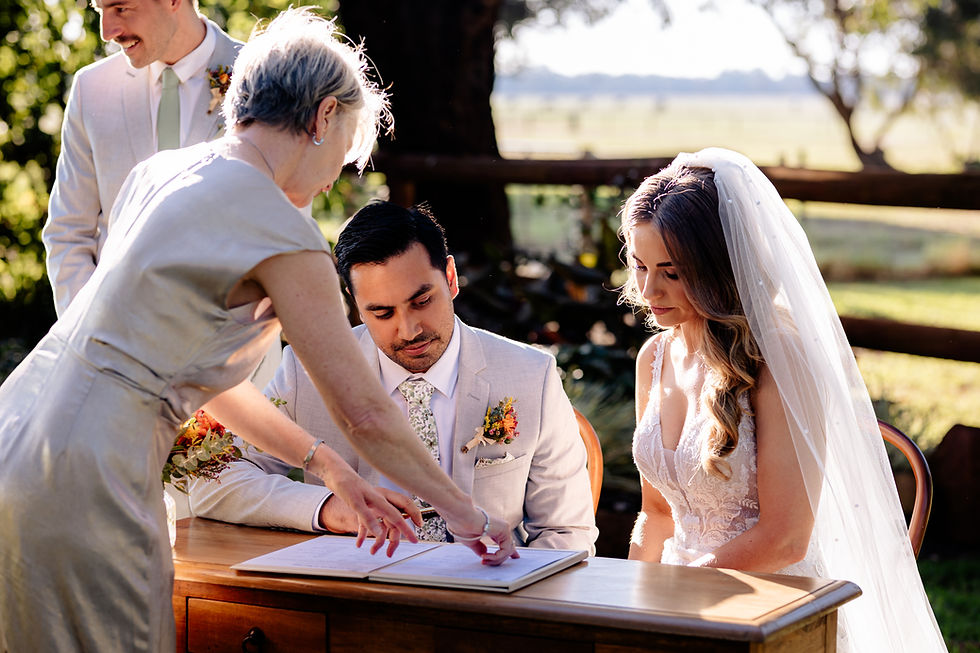
Signing Your Marriage Documents
You’ll sign three marriage certificates, along with your two witnesses and me. One is your keepsake, the other two are used to register your marriage.
Many couples choose parents, siblings or close friends to be their witnesses. I’ve even had some grandparents act as witnesses. As long as they’re over 18 and can understand what’s happening, your witnesses can be anyone you’d like them to be.
While you’re signing, music will be playing and your guests have a few minutes to chat to each other. Your photographer will also be active while you’re signing – another opportunity for great photos.
Now it’s almost time for you to relax, for me to wrap everything up and for the celebrations to continue.
A Few Final Moments
This is the time to let everyone know just where they’re supposed to be after the ceremony and isn’t something that you need to think about at the time.
If family photos are being taken immediately after your ceremony, I’ll invite the relevant people to stay nearby.
Other guests will know whether and when they’re heading to the grazing table, reception or another location. If there are any other special instructions about bubbles, confetti, petals or transport, this is the time they’re given.
The Celebration Begins
Once the ceremony is over, it's time to celebrate! Walk back down the aisle together as a married couple for the very first time.
This is another moment where it's worth slowing down. Hold hands, smile at each other, look at your family and friends, and really take it all in. The ceremony you've spent months planning is over in the blink of an eye, so don't rush through these first few moments together. You'll be greeted with hugs, congratulations and plenty of happy faces before moving on to photos, your reception or whatever you've planned next. However your day unfolds from here, this is where the next chapter of your lives together truly begins.
Conclusion
While every wedding ceremony is unique, most follow a similar flow. Understanding what happens can take away a lot of the uncertainty, leaving you free to enjoy one of the most important days of your life.
Remember too, that while there are a few legal requirements that every Australian marriage ceremony must include, much of the ceremony can be tailored to reflect the two of you. Whether you choose a simple ceremony or something more elaborate, the most memorable ceremonies are the ones that feel genuine, relaxed and true to the couple standing at the front.
Frequently Asked Questions
Do all wedding ceremonies follow the same order?
Not necessarily. Most ceremonies follow a similar structure, but many parts can be moved, added or removed to suit you. There are only a few legal requirements that must be included, giving you plenty of flexibility to create a ceremony that reflects your relationship.
How long does a wedding ceremony usually take?
Most full wedding ceremonies take between 20 and 30 minutes. A shorter legal-only ceremony may take just a few minutes, while a ceremony with readings, personal vows or special rituals may take a little longer.
Do we have to write our own vows?
No. Every couple must say the legal vows required under Australian law, but personal vows are completely optional. If you do choose to write your own, they don't need to be long or poetic. They simply need to sound like you.
Do we have to exchange rings?
No. Exchanging rings is a long-standing tradition, but it isn't a legal requirement. Some couples exchange rings, some have only one ring, and others choose not to exchange rings at all.
Can we personalise our wedding ceremony?
Absolutely. Aside from the legal requirements, there are countless ways to make your ceremony your own. You might include personal vows, a reading, music, children, family members, a symbolic ritual or simply a ceremony that reflects your personalities and relationship.
What if one of us gets emotional during the ceremony?
That's completely normal. Weddings are emotional occasions, and tears, laughter or needing a moment to gather your thoughts are all part of the experience. A good celebrant will give you the time you need and help you feel comfortable throughout the ceremony.
If you have any questions about getting married, feel free to get in touch. I'm always happy to help make the process as easy and stress-free as possible.
Enjoying the blog? Join my newsletter mailing list for occasional wedding planning tips, ceremony ideas and new posts. No spam, and you can unsubscribe at any time.


Comments